 Skip to content

dB Technologies Speakers in Kenya: Line Arrays and How to Choose
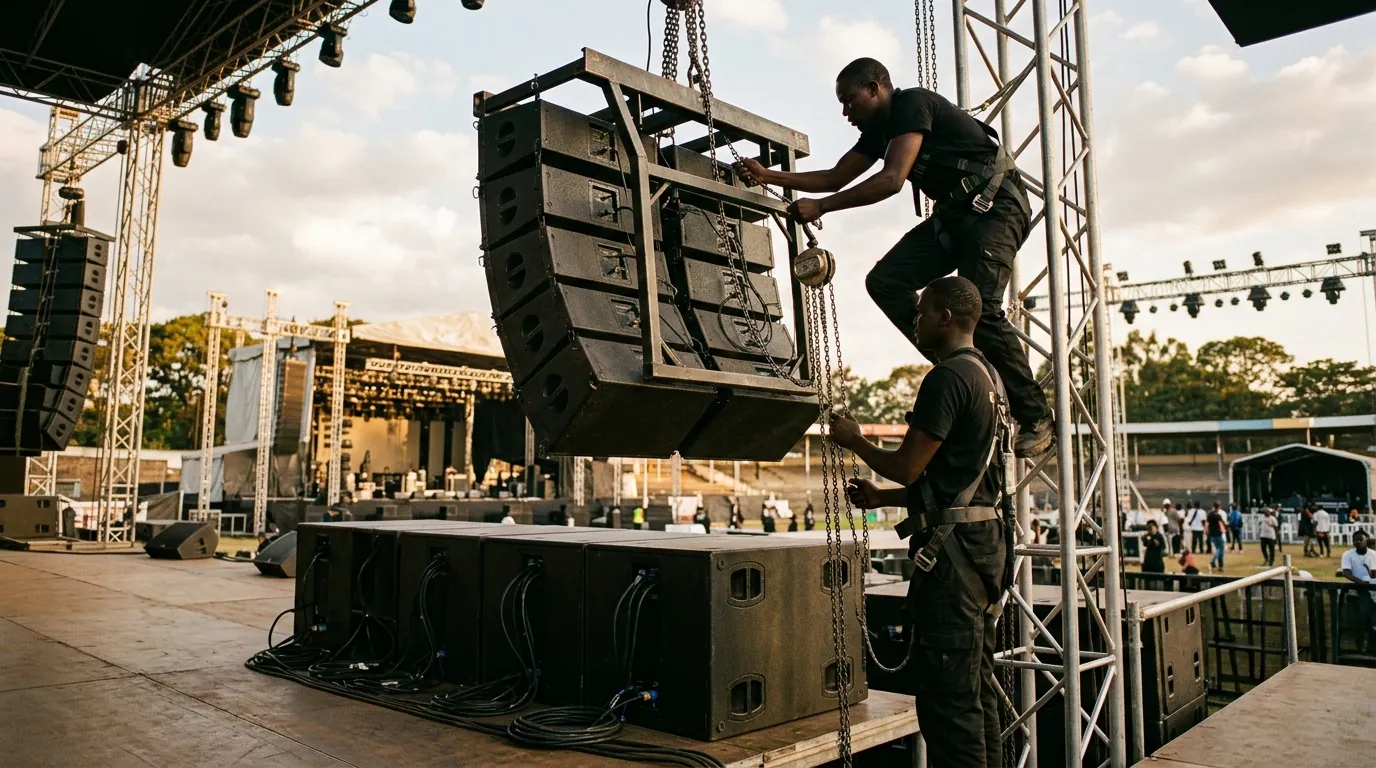
If you are comparing dB Technologies Kenya options, here is the short answer: dB Technologies makes powered speakers, line arrays and subwoofers that suit everything from a small church to a large outdoor event, and the right choice depends on your venue size, coverage and power supply. VTECH Audio Visual Solutions supplies, installs and hires dB Technologies speakers across Nairobi and the rest of Kenya. This guide explains how to choose with confidence.
Key takeaways
- dB Technologies is an Italian pro-audio brand known for active (self-powered) speakers with built-in amplifiers and DSP.
- Line arrays such as the VIO range suit large rooms, long throws and outdoor events. Point-source speakers such as Opera and Ingenia suit smaller rooms and portable setups.
- Subwoofers, fill speakers and delay speakers matter as much as the main speakers for clear, even sound.
- Clean, stable power is critical in Kenya. Plan for generators, voltage protection and proper earthing.
- Permanent installs make sense for weekly use. Hire makes sense for one-off events.
- VTECH gives a fixed quote after a free site survey, delivered within 24 hours.
Who is dB Technologies?
dB Technologies (styled dBTechnologies by the manufacturer) is an Italian professional audio brand. It was born in 1990 in Bologna, Italy, as a brand of AEB Industriale, a company with roots in the audio industry going back to the 1970s, and it is part of the RCF Group. The brand is widely recognised for active speaker and digital amplifier technology, and its products are designed and developed in Bologna.
The catalogue covers line arrays, point-source speakers, subwoofers, stage monitors, column systems and control software. You can browse the full range on the official dBTechnologies VIO series page.
Active vs passive speakers: which is better for Kenyan venues?
A passive speaker has no amplifier inside. It needs a separate power amplifier, a processor and heavy speaker cable. An active (powered) speaker has the amplifier and DSP built into the cabinet, so you only run mains power and an audio signal to it.
Most dB Technologies speakers are active. For many Kenyan buyers this is a practical advantage:
- Faster setup: fewer racks and cables, which helps event crews and churches that set up and pack down every week.
- Matched performance: the factory has tuned the amplifier, drivers and protection to work together, so the speaker is harder to damage.
- Fewer weak points: no long amplifier cable runs to lose power or pick up faults.
Passive systems still have a place in some fixed installs where amplifiers sit in a central rack. The key is choosing one approach and designing the whole system around it.
Line array vs point-source speakers: what is the difference?
A point-source speaker is a single box that spreads sound from one point. It is simple, affordable and ideal for small to medium rooms. A line array is a vertical column of matched boxes that work together to throw sound further with more even volume from the front row to the back. Line arrays lose level more slowly over distance, which is why you see them at concerts, crusades and large conferences.
dB Technologies line array families
The VIO series is the brand’s flagship platform. It includes line arrays, subwoofers, point sources and stage monitors, with models across the VIO L, VIO S, VIO C, VIO X and VIO W ranges. VIO systems are fully powered, with built-in DSP and network control, and are designed for touring and fixed installation. The DVA series is another long-running dB Technologies line array family that many rental companies use.
Point-source and portable options
- Opera: two-way active speakers, such as the Opera 15, used as main PA speakers for small events or as stage monitors.
- Ingenia: point-source active speakers with a compact design, suitable for halls, houses of worship and installs. With an add-on module they can join the brand’s remote control network.
- ES: plug-and-play column systems with a subwoofer and slim tops, popular for presenters, small bands, hotel functions and school assemblies.
Do you need subwoofers?
Yes, for most music-led use. Subwoofers handle the low frequencies that give kick drums, bass guitar and backing tracks their weight. When the subs carry the bass, the main speakers work less hard and speech stays clearer. dB Technologies offers subwoofers within the VIO range and a dedicated SUB series. For speech-only rooms, such as a boardroom or courtroom, subwoofers are usually unnecessary. For worship with a live band, concerts and DJ events, they are essential.
How big a PA system does your venue need?
Speaker size should follow the room, not the other way round. The table below gives a practical starting point. Every venue is different, so a site survey always comes first.
| Venue | Typical approach | What to watch |
|---|---|---|
| Small church, meeting room or classroom | Pair of point-source active speakers or a column system | Speech clarity and reflections from hard walls |
| Medium church, school hall or hotel ballroom | Point-source mains with subwoofers, or a compact line array | Even coverage to the back and side seating |
| Large church or auditorium | Flown line array with subs, plus front fills and delays | Rigging points, balcony coverage, room acoustics |
| Outdoor event or concert | Line array with subwoofers, delay towers for deep crowds | Wind, weather protection, generator capacity |
| Stadium or large open ground | Large-format line arrays with multiple delay positions | Time alignment, noise limits, structural safety |
Church sound systems
Churches need intelligible speech for the sermon and enough power for worship music. Line arrays often help in long, tall sanctuaries. Many Kenyan churches also have hard concrete and glass surfaces, so treatment from our acoustic solutions team can make a bigger difference than adding more speakers. See our church sound systems service for more.
Halls, hotels and conference venues
Multi-purpose halls host weddings, conferences and graduations in the same week. Choose speakers that sound natural at low volume for speeches and still deliver for entertainment.
Outdoor events and stadiums
Outdoors there are no walls to help, so you need more power and careful aiming. Line arrays and delay towers keep the sound even across a deep crowd without blasting the front rows. Our events team plans these systems alongside staging, lighting and screens.
Coverage, fill and delay speakers
Main speakers rarely cover every seat on their own. Good system design adds:
- Front fills: small speakers along the stage edge for the first rows, which sit below the main speaker coverage.
- Out fills: side speakers for wide rooms or seating that wraps around the stage.
- Delay speakers: extra speakers further back, timed electronically so their sound arrives together with the sound from the stage. This keeps the back of a large room or field clear without making the front painfully loud.
- Balcony and under-balcony speakers: for seating the mains cannot reach.
DSP and remote control: why it matters
DSP (digital signal processing) inside each speaker handles crossovers, equalisation, limiting and presets. dB Technologies also uses its RDNet protocol for remote monitoring and control. With the Aurora Net software, an engineer can adjust levels and presets from the mixing position and see speaker status, temperature and limiter activity in real time. For permanent installs this makes troubleshooting faster. For events it means adjustments can be made without climbing to the speakers.
Rigging safety: flying speakers properly
Flown line arrays are heavy and hang above people. Safe rigging is not optional. It requires:
- Manufacturer-approved flying frames and hardware, used within their rated limits.
- Rigging points or trusses that have been checked for the load, including the building roof structure where applicable.
- Safety bonds on every suspended element.
- Trained crew and regular inspection of slings, shackles and frames.
- Proper ground support and ballast for outdoor towers, with attention to wind.
Power and generators in Kenya
Active speakers depend on clean, stable power. Outages, voltage dips and surges are common concerns for Kenyan venues, especially outdoors and in upcountry locations. Plan for:
- A correctly sized generator with headroom for sound, lighting and screens, placed away from the audience to reduce noise.
- Voltage stabilisers or power conditioning to protect amplifiers and DSP.
- Proper earthing to reduce hum and protect people and equipment.
- A UPS for the mixer and control equipment, so a short power cut does not reset the whole system.
- Separate circuits for audio and lighting to avoid interference.
Permanent installation or hire?
A permanent installation suits venues that use sound every week, such as churches, schools, hotels and conference centres. The system is designed for the room, speakers are mounted and aimed once, and cables are hidden. Over time it usually costs less than hiring repeatedly. Learn more about our sound system installation service.
Hire suits one-off events, launches, weddings, crusades and concerts, or venues testing a system before buying. Hire includes delivery, setup, an engineer and collection. See our hire packages or browse individual items on our equipment hire page.
What affects the cost of a dB Technologies system?
Every project is priced on its own requirements. The main factors are:
- Venue size, shape and audience numbers.
- Line array or point-source design, and the number of boxes and subwoofers.
- Fill and delay speakers needed for full coverage.
- Rigging hardware, mounting and any structural work.
- Mixer, microphones, cabling and power protection.
- Acoustic treatment, if the room needs it.
- For hire: event duration, location, transport and crew.
VTECH gives a fixed quote after a free site survey, delivered within 24 hours.
How VTECH designs, supplies, installs and supports your system
- Site survey: we visit your venue, measure the space, check power and rigging points, and listen to how you use the room.
- System design: we choose the right dB Technologies speakers, subwoofers and fills for your coverage and budget.
- Supply: we source the speakers and supporting equipment, including mixers, microphones and cabling.
- Installation: our team mounts or flies the speakers safely, runs neat cabling and sets up power protection.
- Tuning: we set DSP presets, time alignment and equalisation so every seat hears clear, even sound.
- Training and support: we train your team to operate the system and remain available for servicing and upgrades.
We can also combine sound with LED screens and stage lighting for a complete audio visual setup.
Get the right dB Technologies system for your venue
Whether you need a permanent church PA, a conference system or a line array for your next outdoor event, VTECH can help you choose, supply, install or hire the right dB Technologies speakers. Book a free consultation, visit us at Ground Floor, Mpaka Plaza, Mpaka Road, Westlands, Nairobi, or WhatsApp us on +254 182 942 946.
Frequently asked questions
Can dB Technologies speakers be used outdoors in Kenya?
Yes, many dB Technologies speakers are used at outdoor events. For safe outdoor use, protect speakers from direct rain, keep amplified cabinets out of prolonged direct sun where possible, secure ground stacks against wind and run them from a stable generator supply. For permanent outdoor installs, choose models and mounting hardware rated for the environment and ask an installer to confirm suitability.
Can I mix dB Technologies speakers with other brands?
You can, but results are better when the main system is one matched family. Mixing brands often means different tonal character, sensitivity and processing, which makes tuning harder. A common approach is to keep the main line array or mains and subwoofers from one range, then use compatible monitors or fills, all aligned and equalised by an engineer.
How long does a church sound installation take?
It depends on the size of the building, whether speakers are flown, and how much cabling needs to be hidden. Small installs can be done quickly, while large sanctuaries with line arrays, delays and acoustic treatment take longer. VTECH agrees a timeline after the site survey and can schedule work around services so worship is not disrupted.
Do I need a sound engineer to run an active speaker system?
Small setups can be run by a trained volunteer or staff member once the system is tuned and presets are saved. Larger line array systems, live bands and outdoor events benefit from an experienced engineer who can manage mixing, feedback and coverage. VTECH provides engineers with hire packages and offers operator training for permanent installs.
What maintenance do dB Technologies speakers need?
Keep speakers clean and dry, check cables and connectors regularly, and inspect rigging hardware before every use if speakers are flown. Make sure cooling vents on powered speakers are not blocked. Check that firmware and presets are correct after any changes. A periodic professional service helps catch worn components or power issues before they cause a failure during an event.