 Skip to content

Church Sound Systems in Kenya: Speakers, Mics, Mixers and Acoustics
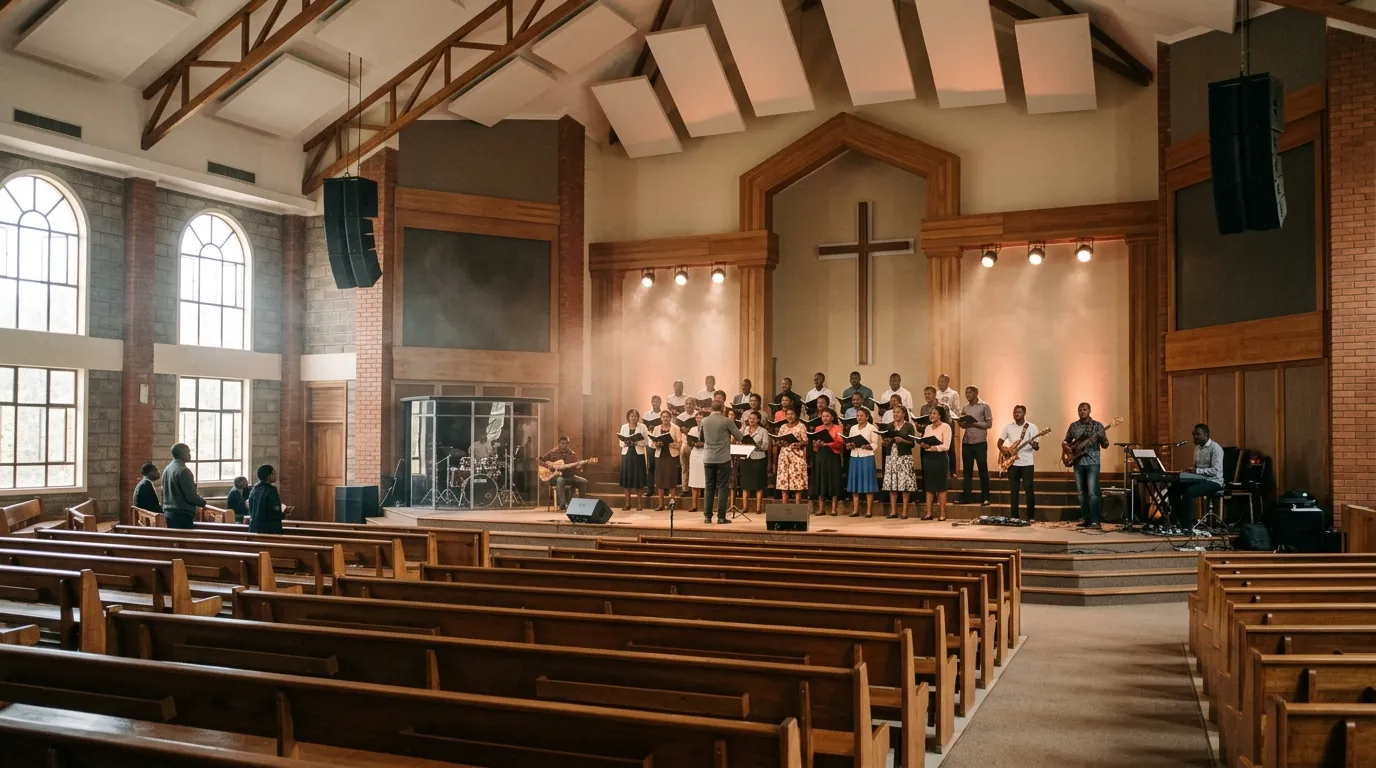
A good church sound system in Kenya is built for one job first: making every word from the pulpit clear in every seat. The right combination of speakers, microphones, an audio mixer and basic acoustics treatment matters far more than raw volume. This guide explains each part in plain English so your pastor, sound team and building committee can plan with confidence.
Key takeaways
- Clarity before loudness. Design the church PA system around the spoken word, then make sure it can handle worship music.
- The room decides the equipment. Ceiling height, tin roofs, open sides and echo all shape which speakers will work.
- Speaker placement prevents feedback. Speakers belong in front of the microphones, never behind the pulpit.
- Digital mixers help volunteers. Saved scenes give a consistent starting point every Sunday.
- Plan in phases. A well-designed system can grow with your congregation and your budget.
Why does speech clarity come first in a church sound system?
A sermon only works if people understand it. In many churches the biggest complaint is not that the sound is too quiet but that it is muddy, boomy or full of echo, especially for elderly members and people seated at the back or along the sides.
Music still matters. The goal is a system that reproduces speech naturally and has enough headroom for lively praise and worship without distortion.
How do you assess a church building before buying sound equipment?
Every sanctuary behaves differently, so a proper assessment comes before any equipment list. These are the main things we look at.
Size, shape and seating
We measure the length, width and height of the space and note where people actually sit, including balconies, side wings and overflow areas.
Ceiling height and tin roofs
Low ceilings limit where speakers can hang. Iron sheet roofs are common across Kenya and bring two challenges: they reflect sound strongly, and heavy rain on the roof adds loud background noise that competes with the pastor. A system that is planned with this in mind keeps speech intelligible even during a downpour, without simply turning everything up.
Reverberation and echo
Reverberation is how long sound lingers after it stops. Hard floors, bare concrete walls, glass and metal roofs all make it longer. Acoustic guidance generally favours a short reverberation time of around one second or less for spoken word, while contemporary worship spaces often aim slightly longer. Rooms with very long reverberation need careful speaker selection and, ideally, some treatment.
Open sides, tents and overflow areas
Many churches have open walls for ventilation or hold services under tents and in overflow shelters. Sound escapes, neighbours may be affected, and wind and traffic noise come in. Here, well-aimed speakers that put sound on the seats rather than the surroundings are essential.
Which speakers are best for a church: point source or line array?
There is no single best speaker. The right choice depends on room depth, ceiling height and reverberation. The table below gives a simple comparison.
| Speaker type | Best suited to | Things to consider |
|---|---|---|
| Point source (conventional cabinets) | Small to medium churches, low ceilings, wide rooms | Simple to install and tune; may need delay speakers for deep rooms |
| Line array | Large, deep auditoriums with enough height to hang the array | Excellent control over long distances; needs proper rigging and design |
| Column speakers | Reverberant halls where speech clarity is the priority | Slim and discreet; narrow vertical coverage keeps sound off walls and ceilings |
A line array is not automatically better. In a deep hall with a low ceiling, a well-designed point source system with time-aligned delay speakers will often perform better. VTECH supplies and installs dB Technologies speakers, and we select the model and quantity to suit the room rather than the other way round.
When do you need delay and fill speakers?
If the back rows are far from the main speakers, they hear less clarity and more room echo. Delay speakers placed partway down the hall, electronically time-aligned with the main system, fix this without making the front painfully loud. Front fill speakers cover the first rows that main speakers often miss, and side fills help in wide or L-shaped buildings.
Where should church speakers go to avoid feedback?
Feedback, the loud squeal or howl, happens when a microphone picks up its own sound from a speaker. The most common cause is speakers placed behind or beside the pulpit, pointing towards the microphones. Main speakers should sit forward of the platform and aim at the congregation, not the stage. Correct placement lets you achieve good volume with fewer problems and less reliance on constant adjustments.
Choosing church microphones for the pastor, choir and instruments
Microphones are where the sound starts, so quality here pays off everywhere else. VTECH supplies and installs Shure microphones for pulpits, worship teams and choirs.
Wired or wireless microphones?
Wired microphones are reliable, affordable and never need batteries, which makes them ideal for fixed positions such as the pulpit, choir and instruments. Wireless microphones give the pastor and worship leaders freedom to move, but they need good batteries or chargers and clean radio frequencies. In Kenya, radio equipment falls under the Communications Authority of Kenya, so we help you choose suitable frequencies and advise on any licensing requirements.
Handheld, headset or lavalier for the pastor?
- Handheld: robust and familiar, but the sound changes as the speaker moves it away from the mouth.
- Headset: keeps a constant distance from the mouth, giving the most consistent and feedback-resistant sound for an active preacher.
- Lavalier (clip-on): discreet, but it sits further from the mouth, so it picks up more room sound and is more prone to feedback in loud rooms.
Microphones for choirs and instruments
Choirs are usually best covered by a few well-placed condenser microphones above and in front of the singers, rather than one microphone per person. Keyboards and bass guitars connect through DI boxes for a clean signal, while drums and acoustic instruments use dedicated instrument microphones. The fewer open microphones you have, the clearer and more stable the overall sound.
Analogue vs digital audio mixer: which suits a volunteer sound team?
An analogue mixer has a physical knob for every function. It is easy to understand but cannot remember settings, so every service starts from scratch. A digital audio mixer adds built-in effects, equalisation, feedback control and, most importantly, scenes.
A scene saves the whole mixer setup. You might create one for the main Sunday service, one for youth service, one for weddings and funerals, and one for midweek prayer. A volunteer recalls the right scene and starts from a known good position. Access levels can lock key settings so a well-meaning volunteer cannot accidentally undo the system tuning.
Stage monitors or in-ear monitors?
Musicians and singers need to hear themselves to stay in time and in tune. Floor wedge monitors are simple and familiar, but they add stage noise that spills into the congregation and the microphones. In-ear monitors send each musician a personal mix directly into their ears, which reduces stage volume, lowers feedback risk and often makes the front-of-house sound cleaner.
Church acoustics treatment basics
Even the best speakers struggle in a room full of echo. Acoustics treatment does not have to mean a full renovation. Practical steps include:
- Absorptive panels on the rear wall to stop sound bouncing back to the stage.
- Treatment on large parallel walls to reduce flutter echo.
- Ceiling or roof underlay solutions that cut reflections and some rain noise from iron sheet roofs.
- Soft furnishings, curtains and carpeted aisles where they suit the space.
Treatment works best when it is planned together with the sound system. Our acoustic solutions team can measure the room and recommend targeted improvements.
How do you get good audio for live streaming church services in Kenya?
A common mistake is sending the main house mix straight to the stream. The house mix is balanced for a room where live drums and voices are already loud, so online viewers often hear too much music and too little speech. A better approach is a dedicated stream mix from an auxiliary or matrix output on the mixer, with its own balance, gentle compression and a pair of ambient microphones to capture congregational singing and atmosphere.
Live streaming church services in Kenya reaches members who travel, the sick and the diaspora. Pair clear stream audio with good visuals from LED screens in the sanctuary and a consistent camera feed, and your online service will feel as engaging as being in the room.
Power, surge protection and backup
Power cuts and voltage fluctuations can damage amplifiers, mixers and wireless receivers. A reliable installation includes properly earthed power outlets, surge protection, and a UPS for the mixer and key equipment so the service is not interrupted when power switches to a generator.
Training volunteers to run church sound
Most church sound teams are volunteers, and their confidence makes a big difference. Good training covers the basics of gain, equalisation and monitor mixes, how to recall scenes, how to handle feedback quickly, and a simple start-up and shut-down routine.
How to phase a church sound project to fit your budget
Cost depends on room size, the number of speakers and microphones, whether you need delay speakers, the type of mixer, cabling distances, rigging and any acoustic treatment. Rather than buying cheap equipment that will need replacing, many churches phase the project:
- Phase one: main speakers, pulpit and worship microphones, and a digital mixer with room to expand.
- Phase two: delay or fill speakers, choir microphones and improved monitoring.
- Phase three: acoustic treatment, in-ear monitors, live-stream audio and stage lighting.
The key is designing the full system from the start so each phase fits in without waste. VTECH gives a fixed quote after a free site survey within 24 hours.
Checklist for church committees
- Can every seat clearly hear the pastor, including the back and sides?
- Do you have problems with feedback, echo or rain noise?
- How many microphones do you need for preaching, worship, choir and instruments?
- Will volunteers operate the system, and do they need saved scenes?
- Do you stream services online, and does the stream sound as good as the room?
- Is your equipment protected from surges and power cuts?
- Is there a plan for future growth, a new building or an overflow area?
- Who will provide training and ongoing support after installation?
How VTECH surveys, designs, installs and supports church sound systems
Our process starts with a free site survey of your sanctuary, where we assess the room, listen to your current system and understand how your services run. We then design a church sound system matched to your space, worship style and budget, supply the equipment, and install it neatly with correct speaker aiming and system tuning. After handover we train your sound team and remain available through our AV maintenance and support service. You can learn more about how we work with congregations on our churches page.
Ready to make every word clear in every seat? Book a free consultation or chat with us on WhatsApp at +254 182 942 946. Visit us at Ground Floor, Mpaka Plaza, Mpaka Road, Westlands, Nairobi, and we will arrange a site survey and send your fixed quote within 24 hours.
Frequently asked questions
How long does it take to install a church sound system?
Timelines depend on the size of the building, the amount of cabling, whether speakers need to be rigged from the roof and any acoustic work required. Smaller churches are often completed quickly, while larger auditoriums take longer. We agree a schedule after the site survey and can plan work around your services so worship is not disrupted.
Can we keep some of our existing sound equipment?
Often, yes. During the site survey we test your current speakers, microphones, mixer and cables to see what is still in good condition and compatible with a new design. Reusing suitable equipment can reduce the initial cost, and we will be honest about anything that is likely to cause problems or limit sound quality.
Do church sound systems need regular maintenance?
Yes. Cables wear out, connectors loosen, wireless microphone batteries degrade and dust builds up in mixers and amplifiers, especially in Kenya's dry seasons. A scheduled check keeps the system reliable, catches small faults before they ruin a service and helps protect your investment. Firmware updates for digital mixers should also be reviewed periodically.
Can the same system serve the main sanctuary and an overflow area?
It can. A digital mixer can send a separate feed to speakers in an overflow hall, children's ministry room or outside tent, each with its own volume. Combined with a video feed to screens, members in the overflow area can follow the service clearly. Planning this from the start avoids costly changes later.
Do you work with churches outside Nairobi?
Yes. We are based in Westlands, Nairobi, and we work with congregations in other towns and counties across Kenya. The process is the same: a site survey, a tailored design, a fixed quote, professional installation and volunteer training. Contact us on WhatsApp to discuss your location and arrange a convenient survey date.