 Skip to content

LED Screens in Kenya: Indoor vs Outdoor, Pixel Pitch and Cost
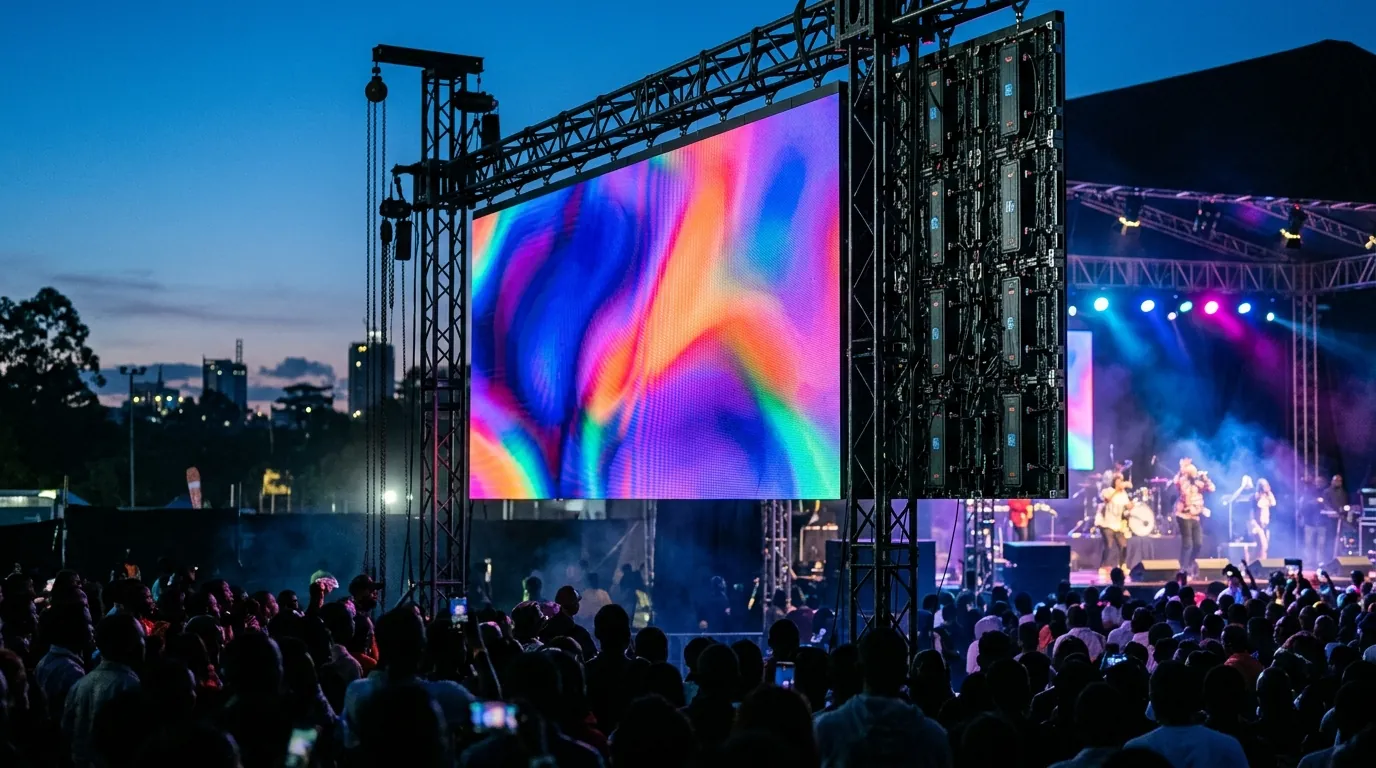
The right LED screens in Kenya come down to three decisions: where the screen will live (indoors or outdoors), how close your audience will stand (which sets the pixel pitch), and whether you need it permanently or just for an event. Get those three right and the rest of the specification, and the budget, follows logically.
Key takeaways
- Pixel pitch is the distance between LEDs in millimetres. Smaller pitch means a sharper image up close, and a higher price.
- A simple rule of thumb: the minimum comfortable viewing distance in metres is roughly equal to the pixel pitch in millimetres.
- Outdoor LED screens need far higher brightness (typically 4,500 nits and above) and weatherproofing (IP65 or better) than indoor screens.
- Cost depends on screen size, pixel pitch, indoor or outdoor rating, structure, processing, power and installation, not on size alone.
- For one-off events, LED screen hire is usually smarter than buying. For daily use, a permanent installation pays off.
LED video wall vs projector vs LCD video wall: which should you choose?
Projectors
Projectors are affordable for large images, but they depend on a dark room. In a bright church hall, a conference venue with windows or any outdoor setting, a projected image quickly looks washed out.
LCD video walls
LCD video walls are built from tiled flat panels. They offer excellent sharpness at close range and suit boardrooms, control rooms and reception areas. The trade-off is the thin bezel line between panels and limited brightness, which rules them out for direct sunlight.
LED video walls
An LED video wall Kenya buyers choose today is built from modular cabinets that join with no visible seams. LED is very bright, works in daylight, scales to almost any size or shape and lasts for many years with proper care. It is the go-to choice for stages, malls, stadiums, roadside advertising and large auditoriums. Explore our full LED screen design and installation service for more detail.
What is pixel pitch and how do I choose the right one?
Pixel pitch, written as P2.5, P3.9, P6 and so on, is the centre-to-centre distance between neighbouring pixels in millimetres. A P2.5 screen has pixels 2.5 mm apart, so it packs in more pixels per square metre than a P6 screen and looks sharper when you stand close.
Finer pitch costs more, so match it to the closest typical viewer rather than paying for detail nobody can see.
Pixel pitch vs typical viewing distance
Use this table as a starting point. The minimum distance follows the common rule of thumb (metres roughly equal to pitch in millimetres). Most viewers will be further back, which is fine.
| Pixel pitch | Minimum comfortable viewing distance | Typical uses |
|---|---|---|
| P1.2 to P1.9 | About 1.2 to 2 m | Boardrooms, broadcast studios, premium retail |
| P2.5 to P2.9 | About 2.5 to 3 m | Conference rooms, church interiors, mall atriums, indoor stages |
| P3.9 to P4.8 | About 4 to 5 m | Event and stage hire, large halls, exhibitions |
| P5 to P8 | About 5 to 8 m | Outdoor events, concerts, stadium side screens |
| P10 and above | About 10 m and beyond | Roadside billboards, building facades |
Also consider content. If you will show small text, such as song lyrics, scripture or a price list, choose a finer pitch than you would for video and large graphics.
Indoor vs outdoor LED screens: what is the difference?
Indoor and outdoor LED screens can look similar on a spec sheet, but they are built for very different conditions. Never put an indoor screen outdoors, even under a canopy.
Brightness in nits
Brightness is measured in nits. Industry guidance puts indoor screens at around 800 to 1,500 nits, which is comfortable in a lit room. An outdoor LED screen typically needs 4,500 nits or more, and 5,000 nits and above for direct sun. Nairobi sits close to the equator, so midday sun is strong all year round and a dim outdoor screen simply disappears.
IP ratings and weather
The IP (ingress protection) rating tells you how well a cabinet resists dust and water. Outdoor screens should be IP65 or better at the front, meaning dust-tight and protected against water jets. That matters during the long and short rains, and in dusty roadside locations. Indoor screens usually have much lower ratings because they never face weather.
Sun, heat and viewing angle
Outdoor cabinets use UV-resistant materials and need ventilation or cooling so the electronics stay within their working temperature. Think about which way the screen faces, when the sun hits it, and the angle from which people will see it, whether from a pavement, a road or a stadium stand.
Cabinet sizes and aspect ratios
LED screens are assembled from cabinets, each holding several modules. Common cabinet sizes include 500 x 500 mm and 500 x 1000 mm, which are popular for stage and rental work because they are light and quick to build, and 960 x 960 mm, which is common for permanent outdoor screens.
Because the screen is built in cabinet steps, the final size is a multiple of the cabinet dimensions. Most content is made in 16:9, the same shape as HD and 4K video, so we usually design walls close to that ratio. Wide or tall custom shapes are possible, but your content then needs to be made to fit.
Processors, controllers and content
An LED wall does not plug straight into a laptop. A video processor takes your sources (laptops, cameras, media players) and scales them to the exact resolution of the wall. Sending and receiving cards then distribute the signal to every cabinet.
Key things to ask about:
- Refresh rate: a high refresh rate prevents flicker and banding when the screen is filmed or live-streamed, which matters for churches and events that broadcast.
- Inputs and switching: how many sources you need and how smoothly you can switch between them during a service or show.
- Content management: for advertising and retail screens, scheduling software lets you update playlists remotely. This overlaps with digital signage in Kenya, where the same principles apply to smaller displays.
Mounting, structures and wind loads
Every LED screen needs a safe structure. Indoors that may be a wall mount, a ground-stacked frame or a flown truss above a stage. Outdoors it could be a steel frame on a building facade or a freestanding pole structure.
Outdoor structures must be designed for wind loads, because a large screen behaves like a sail. A qualified engineer should confirm the foundations and steelwork for permanent outdoor screens, and roadside advertising screens typically need approval from the relevant county government before installation. For stage hire, rigging must be rated for the weight of the cabinets and installed by trained crew.
Power and heat
LED screens draw meaningful power, especially at full brightness, and outdoor screens draw more than indoor ones. Ask your supplier for both maximum and typical consumption so your electrician can size cables and protection correctly.
In Kenya, clean and stable power is just as important as capacity. We recommend surge protection and voltage stabilisation, and for critical screens a UPS or generator changeover so a power dip does not interrupt a service, a live event or an advertising schedule. Heat should be managed with ventilation in enclosed spaces.
Permanent installation vs LED screen hire in Nairobi
If you need a screen for a conference, wedding, crusade, concert or product launch, LED screen hire Nairobi organisers rely on is usually the best value. You get a screen sized for the venue, a processor, a structure and an operator, without owning equipment that sits idle. Browse our LED and AV hire packages to see how this works.
If the screen will be used weekly or daily, as in a church sanctuary, a mall atrium, a retail storefront or a corporate lobby, a permanent installation makes more sense. Many of the churches we support started with hire and moved to a permanent stage screen once they saw the impact on worship and live streaming.
What affects the cost of LED screens in Kenya?
There is no honest single price per square metre, because the final figure depends on several factors working together:
- Screen size: more square metres means more cabinets.
- Pixel pitch: finer pitch uses more LEDs per square metre and costs more.
- Indoor or outdoor rating: outdoor brightness, weatherproofing and cooling add cost.
- Structure and mounting: steelwork, engineering, rigging and access equipment.
- Processing and control: the number of inputs, scaling needs and content software.
- Power and cabling: electrical works, stabilisers and backup power.
- Installation, approvals and support: labour, permits where required, training and maintenance.
- Hire duration and logistics: for events, the number of days, set-up time and location.
At VTECH we do not guess. We carry out a free site survey and give you a fixed quote within 24 hours, so you know exactly what you are paying for.
Maintenance and spare modules
A well-installed LED screen should give many years of service, but like any electronics it needs care. Over time individual LEDs or modules can fail, and dust builds up on outdoor screens. Always order a small stock of spare modules from the same production batch at the time of purchase, so replacements match in colour and brightness.
Regular checks of power supplies, receiving cards, connections and calibration keep the image uniform. Our AV maintenance and support plans cover preventive servicing and fast response when something goes wrong.
How to brief an LED screen supplier
A clear brief gets you an accurate proposal faster. Share the following:
- The location, indoors or outdoors, and photos of the space.
- The closest and furthest viewing distances.
- Your preferred screen size or the wall or stage space available.
- What you will show: video, live camera feeds, slides, lyrics or adverts.
- Whether you need permanent installation or hire, and your dates.
- Available power and any backup supply on site.
- Whether you also need sound, lighting or live streaming.
How VTECH designs, installs, hires and supports LED screens
VTECH Audio Visual Solutions is an audio visual integrator based at Mpaka Plaza in Westlands, Nairobi. Our LED process is simple:
- Survey: we visit your site free of charge to measure, check viewing distances, power and structure.
- Design: we recommend the right pitch, size, brightness and processing, and show you how it fits your space.
- Fixed quote: you receive a clear, fixed quote within 24 hours of the survey.
- Install or deliver: our team builds the structure, installs and calibrates the screen, or sets up and operates hire screens for your event.
- Train and support: we train your team and stay on hand with maintenance and spare parts.
Because we also handle sound, lighting and stage visuals, your LED screen works as part of a complete audio visual system rather than a standalone box.
Get expert advice on your LED screen
Whether you need a permanent LED video wall or a screen for your next event, we will help you get the specification right first time. Book a free consultation and site survey, or WhatsApp us on +254 182 942 946 and we will send you a fixed quote within 24 hours of the survey.
Frequently asked questions
How long does it take to set up a hired LED screen for an event?
Set-up time depends on the screen size, the structure and venue access. A modest indoor screen can often be built in a few hours, while a large outdoor stage screen with truss or ground support may need most of a day. We confirm timings during planning and usually build the day before or the morning of your event.
Can an LED screen be used for church live streaming?
Yes. LED screens work well behind worship teams and preachers, provided the screen has a high refresh rate and is set to a suitable brightness for cameras. This prevents flicker, banding and overexposure on the stream. We match camera settings, screen brightness and stage lighting so the room and the online audience both see a clean image.
How long do LED screens last?
With correct installation, stable power and regular maintenance, a quality LED screen can serve for many years. Lifespan is affected by brightness levels, heat, dust and power quality. Running a screen below maximum brightness, keeping it ventilated and protecting it from surges all help extend its working life and keep colours consistent.
Do I need a permit for an outdoor LED advertising screen in Kenya?
Outdoor advertising screens typically need approval from the county government where the screen will stand, and structures may require engineering sign-off. Requirements differ between counties and locations, so check early in the project. We can advise on the technical documents usually requested, such as structural drawings and screen specifications, to support your application.
Can I play content from my laptop or phone on an LED screen?
Yes. A video processor connects your laptop, media player or camera to the LED wall and scales the image to fit. For permanent screens, content management software lets you schedule playlists and update them remotely. We set up the inputs you need and show your team how to switch sources and load new content.