 Skip to content

Boardroom and Conference Room Solutions in Kenya: 2026 Planning Guide
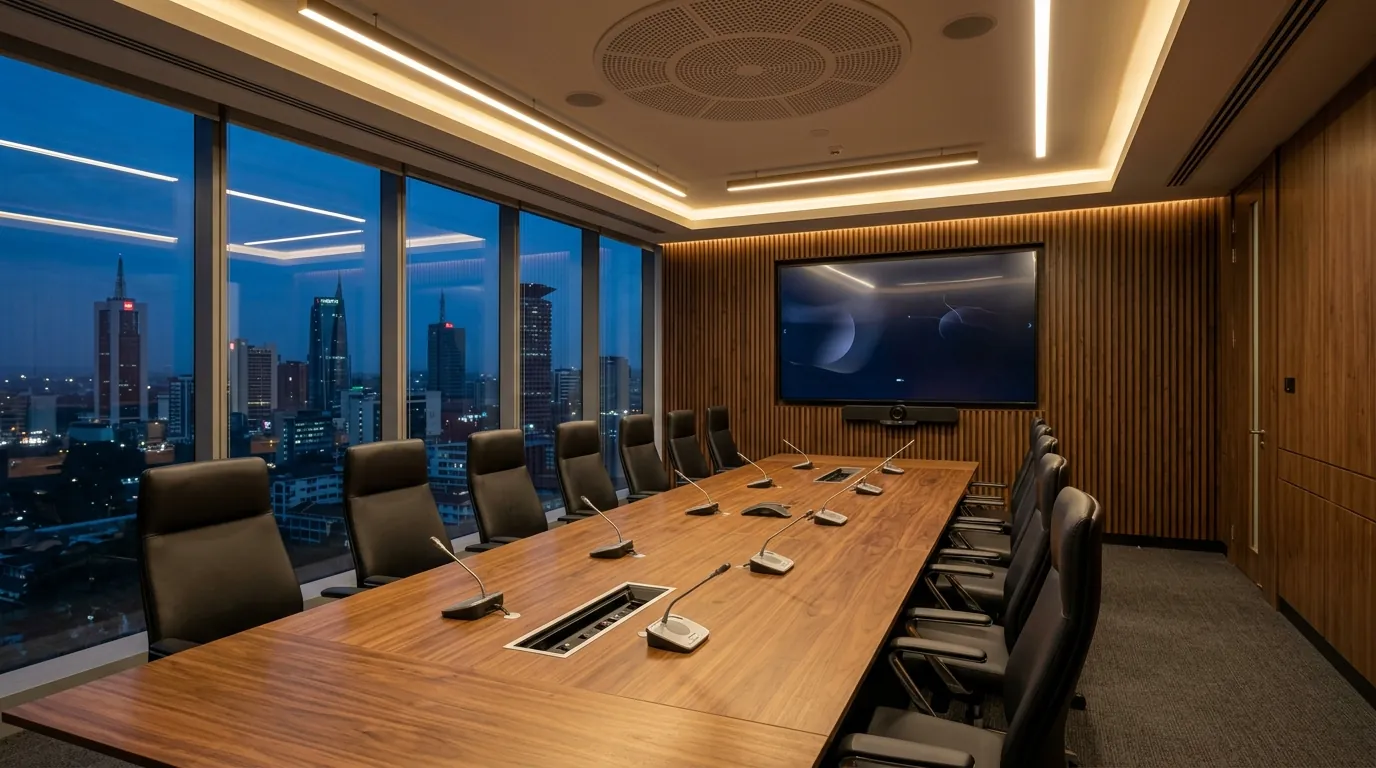
The best boardroom solutions in Kenya combine a correctly sized display, clear audio, a camera that frames everyone, and a simple way to share content and join calls, all designed around the room you actually have. Whether you are fitting out a six-seat huddle space in Westlands or a 40-seat council chamber, planning the audio visual system before you buy equipment saves money and prevents meetings where nobody can hear the remote participants. This 2026 guide explains what to plan, what to avoid and how to get a room that works from the first meeting.
Key takeaways
- Size the display to the farthest seat, not to the budget. A common rule is that the farthest viewer should sit no more than about six times the image height away.
- Audio matters more than video. Good microphones, a DSP with echo cancellation and treated acoustics make or break hybrid meetings.
- Certified Microsoft Teams Rooms and Zoom Rooms kits give staff a one-touch join experience and are easier to manage centrally.
- Councils, assemblies and large conference rooms need delegate microphone systems, and multilingual events may need interpretation.
- Plan power backup, network and cabling from day one, and budget for training and ongoing support.
What does a modern boardroom need?
A modern boardroom is no longer just a table and a projector. Most organisations now hold hybrid meetings every day, so the room has to serve the people in it and the people joining remotely equally well. These are the building blocks of reliable conference solutions in Kenya.
Display or LED wall: what size do you need?
Display size should be driven by viewing distance. The AVIXA display image size standard (often called DISCAS) uses the distance to the farthest viewer to work out the minimum image height. For general presentations, keep the farthest viewer within roughly six times the image height. If people need to read fine detail such as spreadsheets, engineering drawings or financial statements, you need a larger image or a closer seating layout.
In practice, small rooms work well with a single 55 to 65 inch flat panel, medium boardrooms often use a 75 to 86 inch display or two displays (one for people, one for content), and large rooms usually need projection or a fine-pitch LED video wall. LED walls are bright, seamless and suit rooms with a lot of daylight, but pixel pitch must match the viewing distance so text stays sharp.
Cameras that frame everyone
The camera should sit at the front of the room, close to the display and as near to eye level as possible, so remote participants see faces rather than the tops of heads. Small rooms suit wide-angle cameras built into a video bar. Larger rooms benefit from PTZ (pan, tilt, zoom) cameras with presets or intelligent framing that follows the active speaker. Very wide rooms may need more than one camera.
Ceiling and table microphones
Microphones should pick up every seat clearly without forcing people to lean in. Options include beamforming ceiling microphone arrays that keep the table clear, discreet boundary microphones on the table, and gooseneck microphones for formal settings. The right choice depends on table shape, ceiling height and how formal the meetings are.
DSP and echo cancellation
A digital signal processor (DSP) is the brain of the audio system. It mixes the microphones, applies acoustic echo cancellation so remote participants do not hear themselves, reduces background noise from air conditioning and traffic, and balances levels between soft and loud speakers. Skipping a proper DSP in a medium or large room is one of the most common reasons hybrid meetings fail.
Speakers and PA systems
Remote voices must be heard evenly across the room. Small rooms can rely on a video bar speaker, while larger rooms need ceiling or wall speakers so sound is clear at every seat without being too loud at the front. Rooms that double as training or event spaces may need PA systems with handheld and lapel wireless microphones.
Wireless presentation
Guests and staff should be able to share a laptop or phone screen in seconds without hunting for adapters. Wireless presentation systems let users share with a button or an app, and many room kits support content sharing directly from the meeting app. Keep a wired HDMI or USB-C connection at the table as a backup.
Room control
A touch panel at the table or by the door should let anyone switch on the room, start a call, change sources and adjust volume without a technician. Good control design means one button to start and one button to end, with lights, blinds and displays responding together where required.
Cabling and infrastructure
Plan conduits, floor boxes, cable trays and a dedicated equipment rack or cabinet before ceilings and furniture are installed. Using properly rated, labelled cabling and leaving spare capacity makes future upgrades far easier and cheaper.
Room-size planning table
| Room type | Typical seats | Display | Camera | Microphones |
|---|---|---|---|---|
| Small huddle room | 2 to 6 | Single 55 to 65 inch display | Wide-angle camera in an all-in-one video bar | Built-in video bar microphones |
| Medium boardroom | 8 to 14 | 75 to 86 inch display or dual displays | Intelligent wide or PTZ camera with speaker framing | Ceiling array or table boundary microphones with DSP |
| Large conference room | 16 to 40 or more | LED wall, projection or dual large displays | Multiple PTZ cameras with presets or speaker tracking | Multiple ceiling arrays or delegate gooseneck microphones with DSP |
These are starting points. Room shape, ceiling height, windows and how the room is used all change the final design.
How do hybrid meetings and video conferencing work in Nairobi offices?
Most organisations in Nairobi standardise on one platform, usually Microsoft Teams or Zoom, and many also need to join calls hosted on other platforms by partners and donors. The goal of video conferencing in Nairobi boardrooms is simple: walk in, tap once and the meeting starts with good audio and video.
What are Microsoft Teams Rooms and Zoom Rooms?
Microsoft Teams Rooms and Zoom Rooms are dedicated meeting room systems built on hardware that has been tested and certified by the platform. A typical kit includes a compute unit or all-in-one video bar, a touch controller on the table, a camera, microphones and speakers. Microsoft certifies Teams Rooms systems on both Windows and Android, and Zoom certifies appliances, controllers, cameras and audio devices through its hardware certification programme.
Certified kits matter because they are designed to work together, receive updates and can be monitored and managed centrally by IT. They also need the correct room licences and accounts, which should be planned alongside the hardware. VTECH designs and installs rooms around certified equipment so the system behaves the way users expect.
Delegate microphone systems for councils and assemblies
County assemblies, boards, councils and committees need disciplined, recorded debate. A delegate microphone system gives each member a unit with a microphone and request-to-speak button, while the chair unit can control and prioritise speakers. Depending on the system, features may include voting, speaker queues, camera tracking that automatically shows whoever is speaking, and integration with recording and live streaming. These systems are common in government and public sector chambers and in conference centres.
Do you need interpretation?
Regional meetings, NGOs and international conferences hosted in Kenya often run in more than one language. Simultaneous interpretation needs interpreter booths, interpreter consoles and a way for delegates to select their language, typically through infrared or digital receivers with headphones. Permanent and mobile booths are covered by international standards (ISO 2603 and ISO 4043), which set requirements for space, ventilation and sound insulation, so plan interpretation early.
Why acoustics make or break a conference room
Many modern Kenyan offices feature glass partitions, tiled or concrete floors and hard ceilings. These look good but reflect sound, creating echo and reverberation that microphones pick up and send to remote participants. No amount of expensive equipment fully fixes a room that sounds like a hall.
Practical acoustic treatment includes absorptive wall panels, acoustic ceiling tiles or baffles, carpet or rugs, and fabric finishes. For glass walls, options include placing absorption on opposite walls, using acoustic curtains or blinds, and choosing microphones with tight pickup patterns. Sound insulation also matters for confidentiality, so board discussions do not carry into corridors.
Power backup and network: the hidden essentials
Power interruptions and voltage fluctuations can damage equipment and end meetings abruptly. Every serious installation should include surge protection and a UPS sized to keep the core system running, ideally linked to the building generator or solar backup.
The network is just as important. Video calls need stable bandwidth in both directions, wired connections for room systems where possible, and coordination with your IT team on firewall rules, VLANs and quality of service. Meeting room devices should be on a network you can monitor and update.
Training and support after installation
A room is only successful if people use it confidently. Plan short training sessions for staff, executive assistants and IT, and leave simple quick-start guides in the room. After handover, scheduled preventive maintenance, firmware updates and a clear support line keep the system reliable. VTECH offers AV maintenance and support so issues are resolved quickly.
Common boardroom AV mistakes to avoid
- Choosing a display that is too small for the back of the room.
- Relying on a laptop microphone or a single speakerphone in a large room.
- Ignoring acoustics in rooms with glass walls and hard surfaces.
- Mixing uncertified consumer devices that do not work smoothly with Teams or Zoom.
- Leaving out a DSP and echo cancellation in medium and large rooms.
- Installing equipment without UPS, surge protection or a reliable wired network.
- Skipping user training and having no maintenance plan.
- Buying equipment before anyone has surveyed the room.
How much does a boardroom solution cost in Kenya?
There is no single price because every room is different. The main cost factors are room size and seating, display type and size, number of cameras and microphones, whether you need a delegate or interpretation system, the level of acoustic treatment, cabling and building works, control and automation, power backup, and ongoing support. VTECH provides a fixed quote after a free site survey within 24 hours, so you know exactly what you are paying for before work starts.
How VTECH surveys, designs, installs and supports your room
- Site survey: we visit, measure the room, assess acoustics, power and network, and listen to how you hold meetings.
- Design: we specify displays, cameras, microphones, DSP, control and cabling to suit your room and platform, and explain the options clearly.
- Fixed quote: you receive a clear, itemised quote with no surprises.
- Installation: our team installs, configures and tests the system, working around your schedule to limit disruption.
- Training and handover: we train your users and IT team and document the system.
- Support: we provide maintenance, updates and responsive support to keep the room running.
We work with corporate offices, banks, NGOs, government, universities, hotels and conference centres across Kenya, from single huddle rooms to multi-room rollouts.
Plan your boardroom with VTECH
Ready to upgrade your boardroom or conference room? Book a free consultation with VTECH Audio Visual Solutions, or call or WhatsApp us on +254 182 942 946. Visit us at Ground Floor, Mpaka Plaza, Mpaka Road, Westlands, Nairobi, and we will survey your room and send a fixed quote within 24 hours.
Frequently asked questions
Can one conference room support both Microsoft Teams and Zoom meetings?
Yes, in most cases. Many certified room systems run one platform natively and can join meetings on the other through built-in direct guest join or a browser option. Features can be more limited when joining as a guest, so choose your main platform first and confirm with your integrator how the room will handle external meeting invitations.
How long does a typical boardroom AV installation take?
A small huddle room can often be installed and commissioned in one or two days. A medium boardroom usually takes a few days, while large conference rooms, chambers with delegate systems or rooms needing acoustic and building works can take longer. VTECH gives a clear schedule after the site survey and plans work to minimise disruption.
Can you upgrade our existing boardroom instead of replacing everything?
Often, yes. During the survey we check which displays, speakers, cabling and control equipment can be reused safely and which parts limit performance. Many rooms improve significantly by adding a proper camera, better microphones, a DSP and acoustic treatment while keeping sound existing infrastructure, which helps control costs.
Is it possible to record or live stream board and assembly meetings?
Yes. Conference and delegate systems can feed audio and camera signals to a recorder or streaming encoder, and camera tracking can automatically show whoever is speaking. This is useful for minutes, public access to assembly sittings and training. Storage, privacy and approval rules should be agreed with your organisation before recording starts.
What internet speed does a video conferencing room need?
Requirements depend on the platform, video quality and number of simultaneous streams, so check current guidance from Microsoft or Zoom. As a rule, provide a stable wired connection with enough upload and download capacity for HD video, and prioritise meeting traffic on your network. A reliable link matters more than a high headline speed.